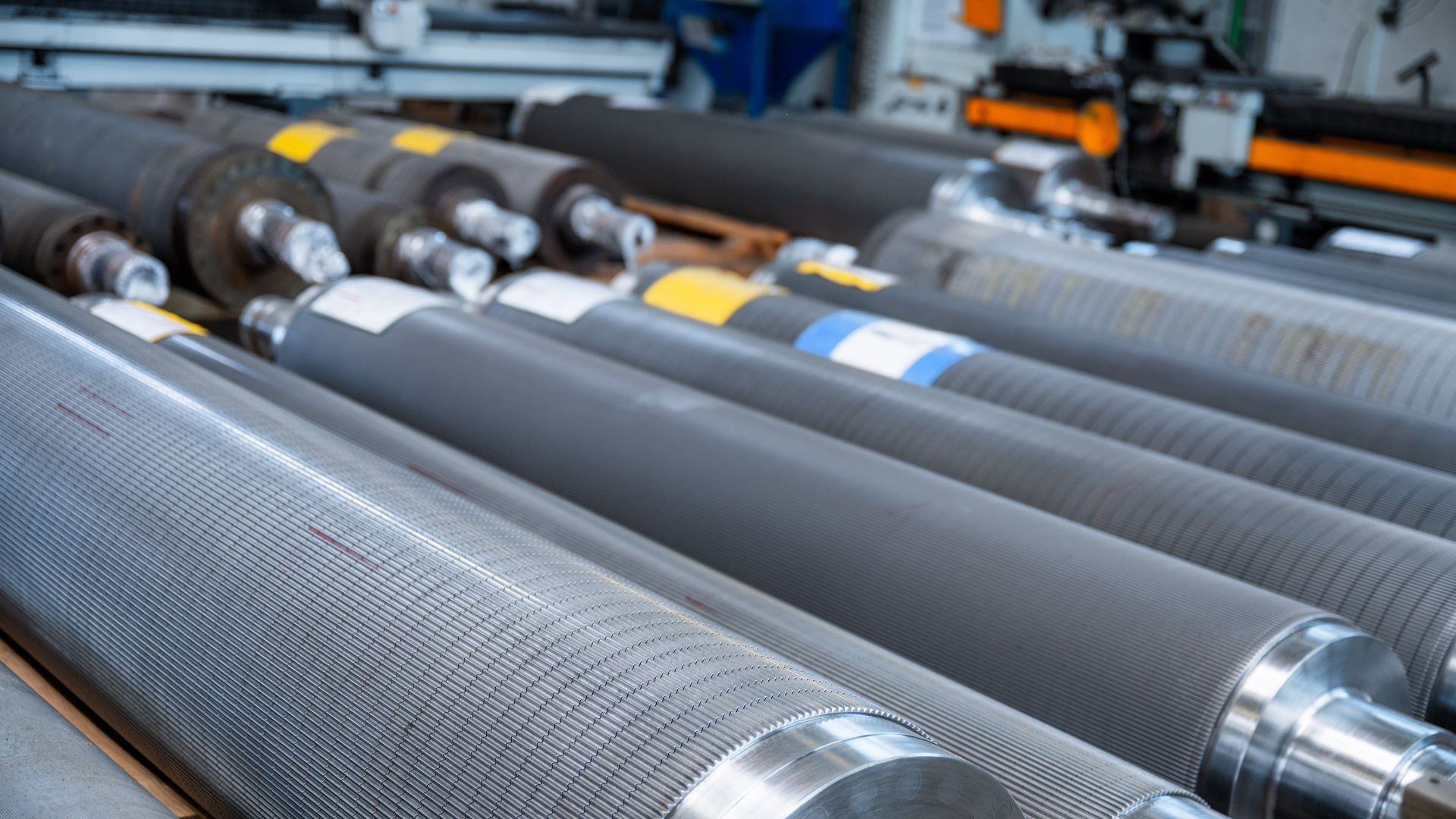
ROCKWELLE® is the tungsten carbide coating we apply to corrugating rolls by thermal spraying. The name derives from the scale on which hardness is measured. The brand is registered. We designate the current version ROCKWELLE® 4.0.
| Feature | Value |
|---|---|
| Material | Tungsten carbide (hard metal) |
| Other materials processed by the plant | Chromium carbide, iron alloys and steels |
| Application process | HVOF, high-velocity oxy-fuel spraying |
| Max. dimensions | ø 620 × 3,000 mm |
| Max. weight | 3.5 t |
| Finishing | Grinding, polishing, finishing in-house |
| Stripping | Own stripping bath for tungsten carbide coatings |
| Applications | Wear protection, corrosion protection, reconditioning of worn components, salvage and repair, electrical and thermal insulation, bearing coatings, wet-chemical attack |
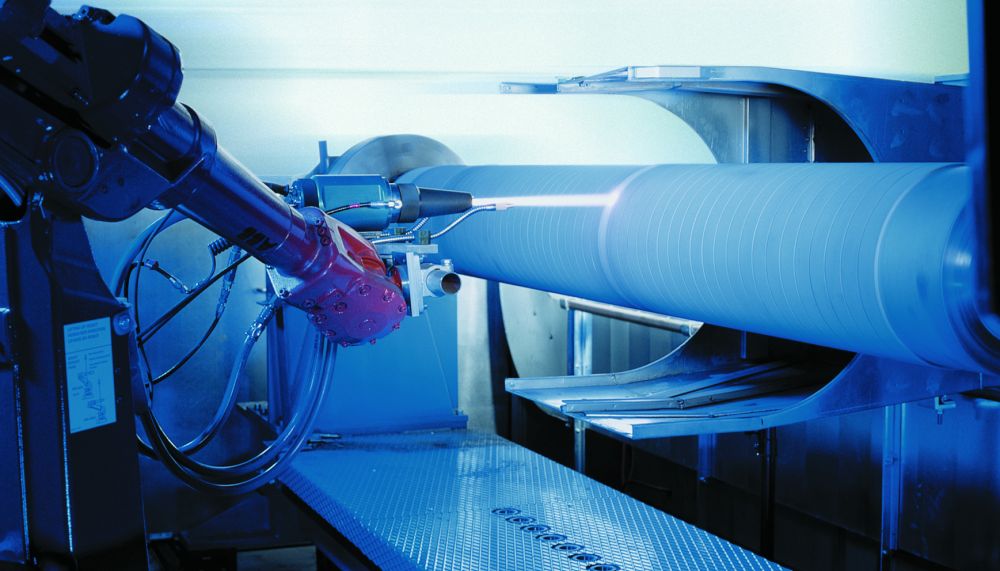
In high-velocity oxy-fuel spraying, tungsten carbide is melted and propelled at very high speed onto the roll surface, where it forms a solid coating. Our plant works automatically. Immediately afterwards, we grind, polish and finish the surface in the same buildings. No transport to a contract coater, no component spending two weeks in transit.
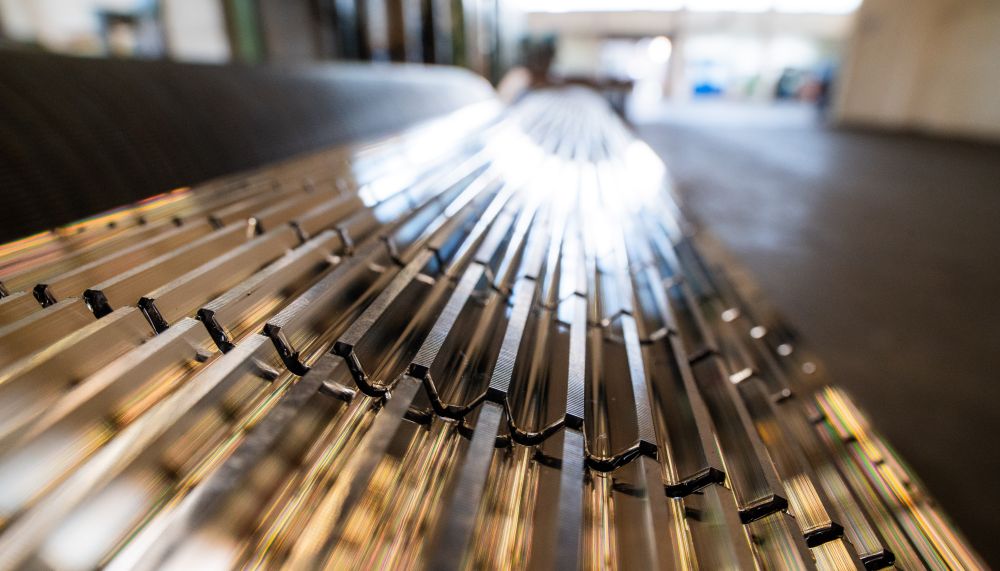
Our plant processes hard metals such as tungsten carbide and chromium carbide as well as iron alloys and steels. Which coating makes sense depends on the application: wear protection has different requirements from corrosion protection or a bearing coating. We outsource simple electroplated chrome coatings and then polish the rolls ourselves.
Send us your machine type, flute type and current coating. We will tell you which coating makes sense in your case, and if your current one is good enough, we will tell you that too.
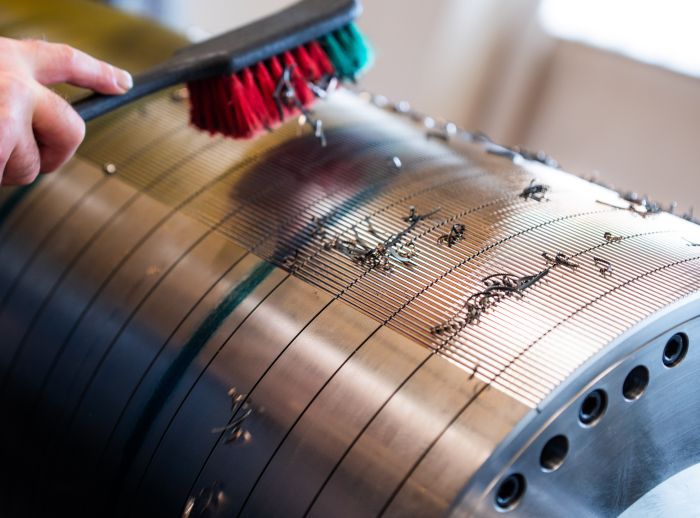
Tungsten carbide is a compound of tungsten and carbon and one of the hardest materials in technical use. In surface engineering, it is used as a hard metal for wear protection.
Both names refer to the same material. Wolfram is simply the alternative name for tungsten, which is why its chemical symbol is W and tungsten carbide is abbreviated to WC.
We mainly use the HVOF process, high-velocity oxy-fuel spraying. This is a thermal spraying process in which the filler material is applied at particularly high speed.
Yes. We strip the old coating electrolytically in our stripping bath, recondition the roll body and recoat it. For many customers, this is the standard procedure.
Our plant takes components up to ø 620 × 3,000 mm and 3.5 t. Besides wear protection, options include corrosion protection, reconditioning of worn components, bearing coatings and electrical and thermal insulation.
The same questions about coating come up again and again: which material, which process, and what happens when the coating is worn off. Here are the short answers.
The roll coating plays a key part in how long a set of corrugating rolls lasts. As a hard coating, tungsten carbide is used where wear protection is the priority. Friese introduced this process for corrugating rolls, applies the coating itself by thermal spraying and then machines the surface to final dimensions, all at its Föritztal site.